Is Crate Regression a Sign of Pain or Illness in Adult Dogs?
Has your previously crate-trained adult dog suddenly started refusing to enter the crate, settling poorly, or resisting bedtime? It's tempting to assume that an old training problem has returned, but a sudden change deserves a closer look.
Yes, crate regression can be a sign of pain, illness, or physical discomfort. A dog that once entered the crate happily may now find it uncomfortable to step inside, turn around, lie down, or get back up. Changes in bladder or bowel habits, appetite, sleep, and general movement can offer additional clues.
Medical problems aren't the only possible explanation. Fear, anxiety, a change in routine, or an uncomfortable crate setup can also cause resistance. The important thing is to check your dog's health and comfort before assuming that more training is the answer.
Start With a Comfort-and-Health Check
When a reliably crate-trained adult dog suddenly changes its behavior, start by looking for what has changed rather than trying to correct the behavior immediately.
Think about your dog's normal routine. Does your dog usually walk into the crate without hesitation? Settle down within a few minutes? Sleep comfortably through the night? If those familiar patterns have changed, try to identify when the change began and what else might have happened around the same time.
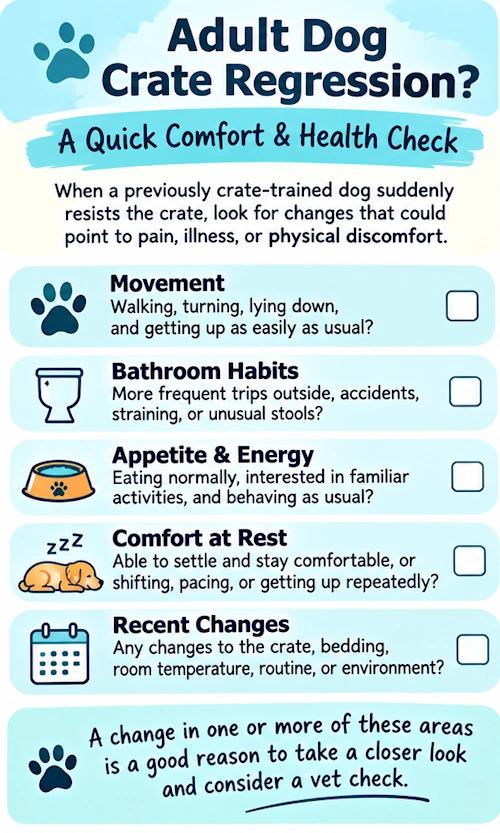
Start with these observations:
- Movement: Is your dog walking, turning, lying down, and getting up as easily as usual?
- Bathroom habits: Is your dog asking to go outside more frequently, having accidents, straining, or producing unusual stools?
- Appetite and energy: Is your dog eating normally, interested in familiar activities, and behaving as usual?
- Comfort at rest: Can your dog settle comfortably, or does it keep shifting position, pacing, or getting up again?
- Recent changes: Has anything changed in the crate, bedding, room temperature, household routine, or surrounding environment?
None of these observations can diagnose a medical problem on its own. However, a change in several areas at once is a good reason to take the situation seriously.
Dogs may show pain through subtle changes in posture, activity, sleep, or behavior rather than obvious crying or limping. Some continue eating and interacting normally despite discomfort, so the absence of dramatic symptoms doesn't rule out a problem. Cornell University College of Veterinary Medicine explains the behavioral and physical changes owners should watch for when recognizing pain in dogs.
From my own experience, when one of my dogs became diabetic, the first thing I noticed was a sudden increase in thirst. After a couple of days of refilling the water bowl more often, I spotted her trying to reach the fountain next door for even more water. Time to see the vet.
The lesson is simple: you know your dog’s normal habits better than anyone else. A change that seems minor in isolation may be worth investigating when it is unusual for that particular dog.
Clues That Point More Toward Pain, Illness, or Physical Discomfort
The next step is to look at what your dog does outside the crate as well as what happens at the entrance.
For example, a dog that hesitates before stepping into the crate may be reacting to an unpleasant experience. But if the same dog is also reluctant to climb stairs, struggles to rise after resting, or repeatedly changes position when lying down, physical discomfort becomes a more important possibility to investigate.
Pay particular attention to the following patterns.
Difficulty moving or changing position
A dog may hesitate before entering, step awkwardly over the crate threshold, struggle to turn around, or remain standing instead of lying down. You might also notice stiffness after sleeping, limping, reluctance to jump, or difficulty getting up.
Joint problems, arthritis, muscle strains, injuries, and other painful conditions can affect ordinary movements. These signs are not limited to older dogs, and age alone should never be used to explain away a sudden change.
Restlessness and difficulty settling
Some dogs in discomfort repeatedly stand up, lie down, shift position, or pace. Others become unusually quiet, withdraw from interaction, or avoid activities they previously enjoyed.
Whining, trembling, excessive licking of a particular area, unusual reactions to touch, or panting when the dog is resting in a comfortable temperature can add to the concern. These signs have several possible causes, so consider the overall pattern rather than focusing on just one behavior.
Changes in eating, drinking, or toileting
Digestive upset, urinary problems, and other illnesses may affect a dog's comfort and ability to settle. Watch for vomiting, diarrhea, changes in appetite or thirst, more frequent requests to go outside, and new indoor accidents.
A dog that suddenly cannot remain comfortable overnight may also be dealing with a need to urinate or defecate more frequently. Don't assume that accidents or repeated requests to go outside are deliberate misbehavior.
Discomfort that isn't immediately obvious
Skin irritation, sore paws, dental pain, and other localized problems may affect a dog's general behavior even when movement looks normal. Heat and uncomfortable bedding can also make the crate unpleasant.
I remember when one of my dogs picked up foxtails in his paw while we were out on a country trail. He wasn't complaining, but something about the way he moved caught my attention. I'm glad I checked, because the vet removed eight foxtails, including one that had progressed up his leg. Foxtails can be dangerous, so don't overlook a change in movement just because your dog isn't crying or limping dramatically.
A dog may look fine at first glance but behave differently during ordinary activities. Watch what happens naturally rather than repeatedly asking the dog to enter, turn, lie down, or get up to see whether it reacts.
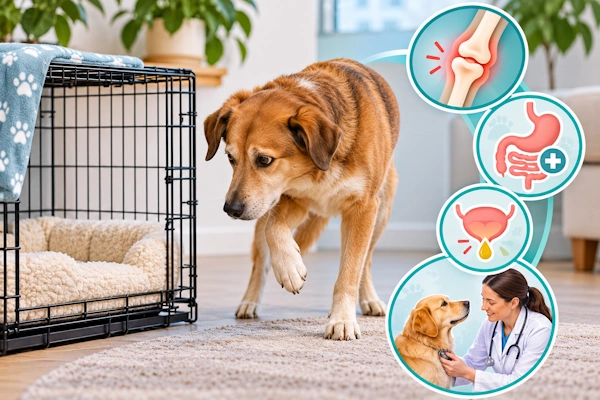
The important point isn't that every reluctant dog is in pain. It is that physical discomfort can look like a behavior problem, and owners shouldn't have to wait for dramatic symptoms before seeking advice.
What to Check in the Crate Setup Before You Retrain
A sudden change doesn't always mean that your dog is ill. Sometimes the crate or its surroundings have become less comfortable, even though the dog used to be happy there.
Start by inspecting the setup and thinking about anything that has changed recently.
Crate size and ease of entry
Your dog should have enough room to stand, turn around, lie down, and rise comfortably. Check whether the entrance is awkward to negotiate or whether the dog now has difficulty stepping over the threshold.
A crate that was suitable before may become less comfortable if your dog has grown, gained weight, developed mobility limitations, or needs a different arrangement.
Bedding and floor traction
Check that bedding is clean, dry, and comfortable. Look for bunched-up material, damaged surfaces, or bedding that takes up too much of the available space.
Also consider the approach to the crate. A slippery floor can make a dog hesitant to enter, particularly if it already feels unsteady. A secure, nonslip approach may help, provided it doesn't introduce another obstacle.
Temperature and ventilation
A crate in a warm room, direct sunlight, or an area with poor airflow may become uncomfortable. Check the room's temperature and ventilation, and make sure your dog can rest without overheating.
Don't cover the crate in a way that restricts airflow or traps heat.
Noise, location, and distractions
Has a new appliance started humming nearby? Is the crate now next to a busy doorway, a noisy window, or an area where other pets interrupt your dog? Has the household routine changed?
A dog that suddenly avoids the crate may be responding to something that happened near it or to a new source of disturbance.
Safety and access
Inspect the crate for sharp edges, damaged latches, loose components, and anything that could snag your dog's coat, collar, or tags. Follow safe crating practices and remove anything that could pose a hazard.
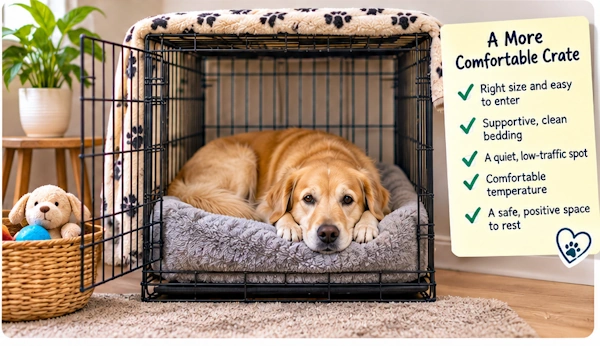
Use this quick checklist to organize your inspection:
- My dog can enter and leave without obvious difficulty.
- There is enough room to turn around, lie down, and rise.
- The bedding and floor are clean, dry, and comfortable.
- The room is suitably cool and well ventilated.
- The location is reasonably quiet and free from new disturbances.
- The crate and its surroundings are safe and in good condition.
If you find an obvious problem, correct it where you can and observe whether your dog is more comfortable. But don't use an improved setup as proof that a medical problem has been ruled out.
If your dog continues to struggle with movement, settling, or toileting, contact your veterinarian before beginning a retraining program.
When to Call the Vet Before Treating This as a Training Issue
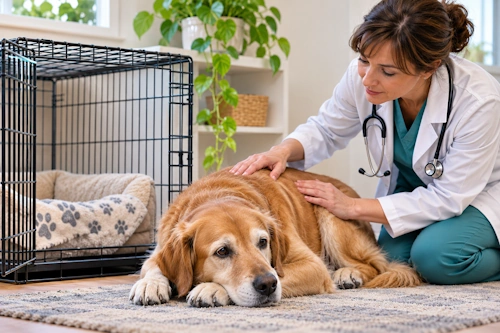
If crate regression appears suddenly and you cannot explain the change, contacting your veterinarian is a sensible first step. This is especially important when the change occurs alongside other physical or behavioral symptoms.
Seek emergency veterinary care for serious warning signs.
These include difficulty breathing, collapse, severe or sudden pain, or repeated attempts to urinate with little or no urine passing. A swollen or distended abdomen accompanied by repeated unproductive retching is also an emergency warning sign.
Don't wait to see whether retraining helps when these symptoms occur.
Contact your veterinarian promptly about new or persistent changes.
Arrange veterinary advice if your dog develops new limping, stiffness, difficulty standing or lying down, persistent restlessness, panting at rest without an obvious explanation, repeated vomiting or diarrhea, appetite changes, urinary changes, or a sudden unexplained change in behavior.
If you suspect pain, avoid forcing your dog into the crate or repeatedly testing the movement that seems uncomfortable. Don't give human pain medication unless your veterinarian specifically directs you to do so.
What if crate regression is the only change?
If your dog is otherwise comfortable, moving normally, eating and drinking as usual, and toileting normally, check the crate setup and note when the problem occurs. Consider whether the behavior is linked to a particular time, sound, room, or recent experience.
Contact your veterinarian if the change persists, recurs, or becomes more concerning. You don't need to wait for several symptoms to appear before asking for advice.
Before an appointment, write down when the behavior started, whether it is getting better or worse, and any accompanying changes in movement, appetite, sleep, or toileting. A short video of naturally occurring movement or behavior may help your veterinarian understand what you've observed, provided recording it doesn't distress your dog or delay needed care.
While not related to crate regression, the only time my dog didn't want to do anything except lie on a cold floor, was after he was diagnosed with kidney failure. The symptoms leading up to that were quite subtle.
Recognizing when a problem needs professional attention is part of good dog care. You don't have to identify the cause yourself; you just need to recognize when a change deserves investigation.
If a health problem or physical discomfort is contributing to your dog's crate regression, addressing that issue comes before rebuilding the dog's comfort with the crate.
For a broader look at why crate regression happens and how the different causes fit together, continue to our guide to crate regression in adult dogs. Once health and comfort concerns have been considered, you can decide whether a gradual retraining plan is the appropriate next step.
Before You Go...
If you like the content of this page, as well as others on my site, please give it some love by clicking on the heart in the lower right hand corner. This helps me keep providing enjoyable and useful content.
Thank you.
- Home
- Crates
- Crate Regression in Adult Dogs
- Pain or Illness
